
Scarlet Kingsnake (Lampropeltis elapsoides)

Scarlet Kingsnake (Lampropeltis elapsoides)



Description: The scarlet kingsnake is a small, slender species that grows 14-20 in (36-50 cm) long, with smooth scales and small heads. Its body is typically encircled by alternating bands of red, black, and yellow/white. This tri-colored pattern closely resembles that of the scarlet snake (Cemophora coccinea), leading to frequent misidentifications. The two can be distinguished by several traits: scarlet snakes have elongated, pointed snouts and plain, light-colored bellies, whereas scarlet kingsnakes have shorter, more blunt snouts, and banding that typically encircles the entire body of the snake. In addition, the red bands of scarlet kingsnakes are generally narrower compared to the broader red bands of a scarlet snake, though this is not always the case.
Their bright, alternating bands are a classic case of Batesian mimicry, being a non-venomous species that gains protection by “mimicking” the appearance of venomous coral snakes. Field experiments show that predation risk is lower in regions where coral snakes are present (sympatry), but scarlet kingsnakes may face more attacks in regions where coral snakes are absent (allopatry), reflecting frequency-dependent predation. Despite this, they persist even in areas north of the coral snake’s range.
Taxonomic Notes: The scarlet kingsnake was long considered a subspecies of the eastern milk snake; previously Lampropeltis triangulum elapsoides. Early herpetologists grouped it with milk snakes because of its similar tri-colored pattern and overlapping range. However, genetic studies have since shown that the “milk snake complex” is not a single species, but several distinct lineages. Among these, the scarlet kingsnake forms its own branch, with consistent differences in size, head shape, and banding. For this reason, modern taxonomy now recognizes it as a separate species, Lampropeltis elapsoides.
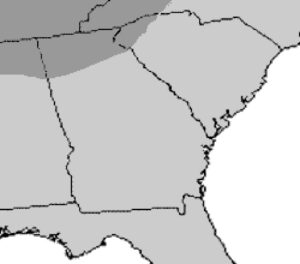
Range and Habitat: Scarlet kingsnakes occur throughout the southeastern United States, from Virginia south through Florida and west to Louisiana. They are widespread in Georgia and South Carolina but are most frequently encountered in the Coastal Plain. Disjunct populations in the Piedmont and Blue Ridge are sparse and much less common.
They are most often associated with the Atlantic and Gulf Coastal Plains, where sandy soils and pine or mixed hardwood forests dominate. Though considered primarily fossorial, they are not confined to the ground. Most individuals are encountered beneath logs, bark, or debris in well-drained, sandy woodlands, but extensive observations and studies suggest that they show a degree of arboreality that is not always recognized for the species. Individuals are frequently observed climbing into rotting pine stumps, scaling shrubs, and climbing several feet up trees underneath loose bark. This arboreal behavior is likely linked to foraging behavior for favored prey items and serves as safe refugia from predators.
Habits: Scarlet kingsnakes are secretive and largely nocturnal, often surfacing on warm, humid nights in spring and early summer. They may also be seen crossing roads after rain when soil becomes oversaturated. While primarily fossorial, their tendency to slip beneath bark and occasionally ascend trees highlights their versatility. Additionally, they can be encountered in barns and human structures where they are attracted by suitable cover, and diverse prey items.
Scarlet kingsnakes feed primarily on small reptiles, especially lizards and other snakes. Young individuals are avid lizard eaters, particularly favoring skinks. Adults may also take small snakes, including other colubrid (e.g. ringneck, pinewoods snakes). Their small, pointed heads are well-suited to probing under bark or into tight crevices to capture secretive or hard to capture prey. Scarlet kingsnakes are mid-level predators that play an important role in regulating other small reptile populations while serving as prey to other snakes (e.g. racers, coachwhips, coral snakes), raptors, and mammals (e.g., raccoons, armadillos, opossums, feral cats, etc.).
Mating takes place in spring, with females laying clutches of 3-9 elongate, leathery eggs in early summer. Eggs are deposited beneath logs, in decaying wood, or in loose soil. Hatchlings emerge in late summer, 5-7 in (13-18 cm) long, and appear as miniature versions of the adults, though often displaying much more vibrant coloration.
Conservation Status: This species remains widespread and locally common, though it is seldom seen due to its secretive lifestyle. Habitat loss through urbanization and fire suppression has reduced suitable pine and scrub habitats in parts of its range. Populations may also decline because of road mortality and human persecution when misidentified as a coral snake. Despite this, scarlet kingsnakes have global statuses of globally secure, and have state statuses of stable and not of major conservation concern in both Georgia and South Carolina, where they are protected by law.