
Rough Earth Snake (Virginia striatula)
Photos by J.D. Willson unless otherwise noted
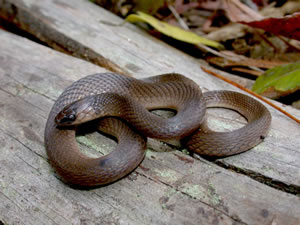
| Description: The rough earth snake is a small — 7-10 inches (18-25 cm) -– fairly slender brown to gray snake with keeled scales and a pointed snout. The young are darker in coloration than the adults and may have a light band on the neck, which is sometimes lost as the species matures. The belly is tan to whitish and is not sharply defined in color from the dorsum (as in the worm snake, Carphophis amoenus, and redbellied snake, Storeria occipitomaculata). Keeled scales differentiate this species from the similar smooth earth snake (Virginia valeriae) and worm snake. Brown snakes (Storeria dekayi) have dark markings on the back and neck.
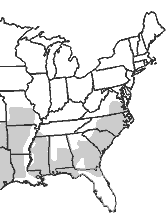
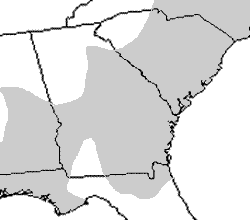
Range and Habitat: This species can be found throughout most of the southern Coastal Plain of the United States but is absent from the Mississippi River Valley, peninsular Florida and southwestern Georgia. A few records exist from the Piedmont, but it is quite rare in that region. This species is found in a variety of forested habitats with plenty of ground cover. In western portions of this species’ range (Texas) this species can be abundant, but in our region it is fairly uncommon. Habits: Rough Earth Snakes are fossorial (live underground) and are most often found hiding beneath logs, leaf litter, or other debris. They feed almost exclusively on earthworms. This species is viviparous, giving live birth to as many as 10 young in the summer. Conservation Status: Rough earth snakes are generally uncommon and not protected in most of their range. They are protected throughout the state of Georgia. Pertinent References: Stewart, James R. 1988. Facultative Placentrophy and the Evolution of Squamate Placentation: Quality of Eggs and Neonates in Virginia striatula. The American Naturalist. 133:111-137. Account Author: Jason Norman, University of Georgia – edited by J.D. Willson |