
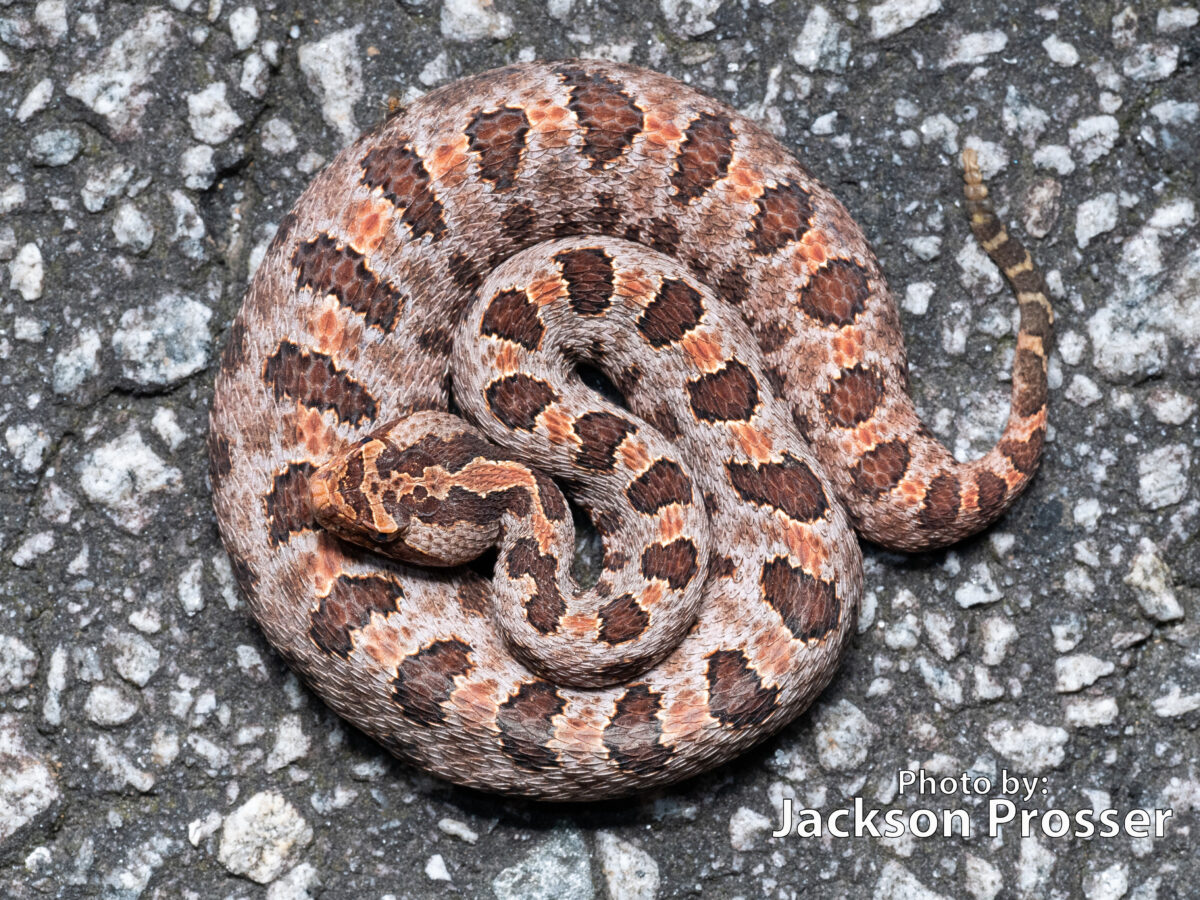
Pygmy Rattlesnake (Sistrurus miliarius) – Venomous

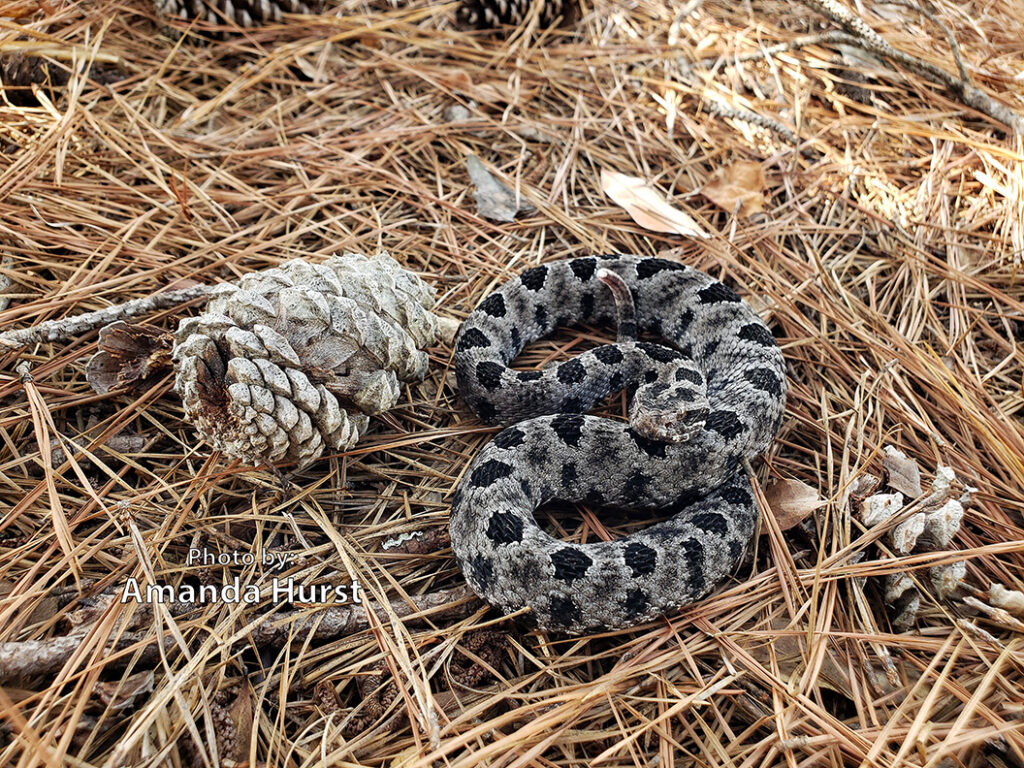

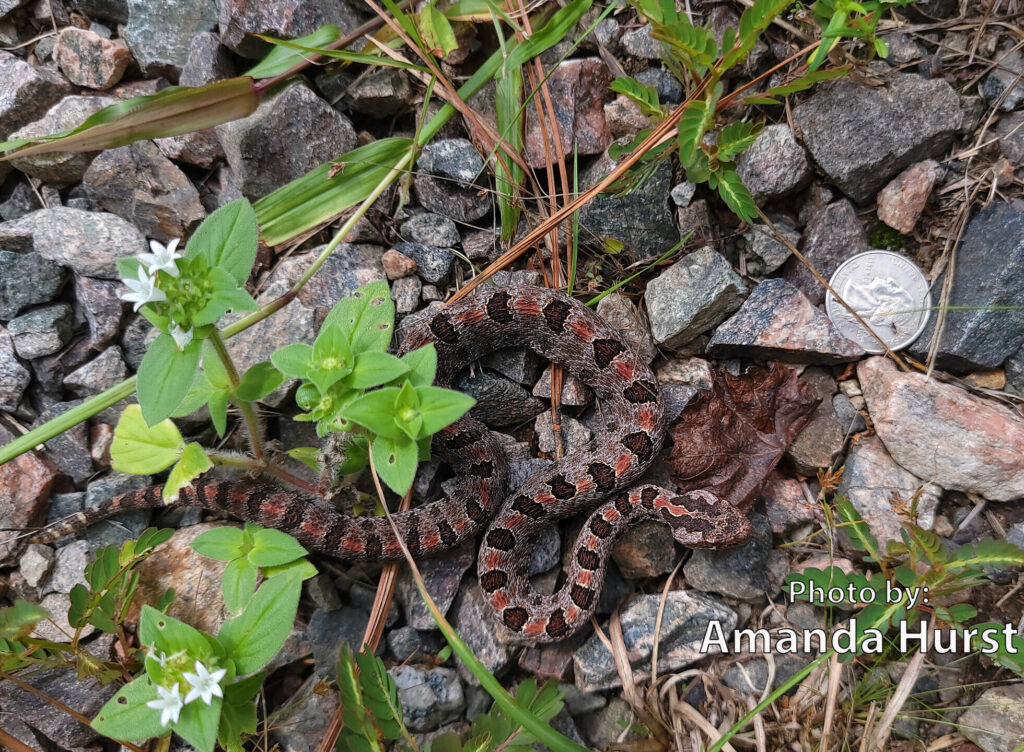

Description: Pygmy Rattlesnakes are the smallest rattlesnakes in the U.S., averaging 16-24 in (40-60 cm) in total length, with a maximum length of 31 in (78 cm). Both subspecies have a stout body, a defined head, and an extremely small rattle that produces only a faint buzzing sound (often not even heard). Sexual dimorphism is slight, with females being larger and males having proportionally longer tails. Both the Carolina (Sistrurus miliarius miliarius) and Dusky (Sistrurus miliarius barbouri) pygmy rattlesnakes share several key features, including a row of blotches running down the spine, lateral spotting, and a dark bar extending from the eye to the corner of the mouth, usually with a smaller white bar running through it. The color of this facial bar ranges from jet black to reddish brown, depending on the individual. An orange or brown stripe running down the spine is usually present in both subspecies, though it varies in prominence. Juveniles are easily recognized by a bright yellow tail tip, which they use for caudal luring to attract amphibian prey.
The Carolina Pygmy Rattlesnake body color ranges from gray to tan or lavender, and in some regions (notably northern Georgia and eastern North Carolina), individuals may be bright orange or brick red. The Carolina subspecies is considered the most colorful of the pygmies.
The Dusky Pygmy Rattlesnake is typically less vibrant, with a body color ranging from bluish gray to nearly black. This gives the Dusky a more cryptic appearance compared to the Carolina subspecies.
Range and Habitat:
- Dusky Pygmy Rattlesnake (Sistrurus miliarius barbouri): This subspecies ranges widely across peninsular and northern Florida, extends into southern Georgia, and ranges westward into southern Alabama and Mississippi. This subspecies is strongly associated with moist and aquatic environments. It is frequently encountered in cypress swamps, marshes, canal and pond margins, and wet prairies, but also inhabits lowland pine flatwoods, hydric hammocks, and disturbed wetlands. Their close association with water often brings them into contact with humans in agricultural ditches and along canal banks.
- Carolina Pygmy Rattlesnake (Sistrurus miliarius miliarius): This subspecies occurs from southeastern North Carolina through the coastal plain of South Carolina and into northeastern Georgia. Compared with the Dusky, this subspecies is more closely associated with xeric uplands. It is often found in longleaf pine sandhills, dry pine flatwoods, and sandy ridges. However, it also inhabits mixed pine-hardwood forests, floodplains, and agricultural edges where sandy soils provide cover.
In summary, Carolina Pygmies prefer more open, drier habitats than the lower, wetter environments preferred by the Dusky.
Habits: Both subspecies are primarily sit-and-wait predators, spending more than 90% of their time coiled in ambush near cover or along prey travel routes. Activity is strongly seasonal and influenced by temperature and precipitation, with peak surface activity in spring and late summer. Pygmies exhibit nocturnal activity, particularly in the hot months, where movement is linked to warm, humid conditions. Pygmy rattlesnakes also show a clear moon-influenced activity pattern, moving more frequently on dark nights (particularly during crescent or new moon phases) and reducing activity under bright full moon conditions, likely due to predator avoidance and prey availability. Rainfall tolerance differs between subspecies: Carolina pygmies reduce movement during heavy precipitation, while dusky pygmies remain relatively active even in wetter conditions.
Pygmy Rattlesnakes are generalists and consume a broad array of prey. Their diet includes frogs, lizards (primarily anoles), small snakes (ringnecks, garters), rodents, birds, and large invertebrates such as spiders and centipedes. Frogs are particularly important prey in many populations, and pygmies select ambush sites based on frog scent cues, positioning themselves where encounter rates with frogs are higher. Neonates use their yellow tail tip as a lure by wiggling it to entice amphibians into striking range. Known predators include kingsnakes, raptors, wild turkeys, raccoons, and feral cats. Their small size makes them particularly vulnerable to predation.
They are ovoviviparous, meaning they give birth to live young rather than laying eggs. They reach reproductive maturity quickly compared to other pit vipers, with males maturing around 3 years of age and females around 2-3 years. Typical litters range from 3 to 12 neonates, born in late summer or early fall.
Despite their small size, pygmies rely on camouflage and crypsis rather than escape. When threatened, they vibrate their small rattles, which produce a faint sound often inaudible beyond a few feet. They may also strike readily when harassed.
Venom and Bites: The venom of the pygmy rattlesnake is primarily cytotoxic (attacks cells) and evolved to immobilize and digest small vertebrate prey. Studies show that it is effective against a wide range of prey, although toxicity varies across species. For example, native prey such as green anoles and cotton mice exhibit partial resistance. In contrast, non-native species such as house mice are more vulnerable, suggesting long-term coevolution between predators and prey.
There has never been a documented death from a pygmy rattlesnake bite, though envenomation can cause intense local pain, swelling, bruising, and tissue necrosis at the bite site. Because of their small size, pygmies deliver less venom than larger rattlesnakes. However, all bites from pygmy rattlesnakes should be treated as emergencies due to the risk of tissue damage and secondary infection.
Conservation Status: The Carolina Pygmy Rattlesnake is of Special Concern in North Carolina and is protected under the state’s Endangered Species Act. Habitat fragmentation, development, road mortality, and human persecution have caused significant population declines. Its small body size increases predation pressure, and collection for the pet trade poses localized threats. The Dusky Pygmy, while more widespread in Florida, is also affected by habitat loss and frequent human encounters, given its small home range and tendency to inhabit the edges of suburban and agricultural areas. Both subspecies benefit from conservation of longleaf pine ecosystems and associated wetlands. The dusky and Carolina pygmies are listed as species of least concern. They are not protected by law in Georgia and South Carolina.
Pertinent References
- Neill, W. T. (1964). Taxonomy and natural history of the pygmy rattlesnake, Sistrurus miliarius. Herpetologica, 20(1), 1-17
- Gibbons, J. W. (1977). Selected aspects of the life history of the pygmy rattlesnake, Sistrurus miliarius. Herpetologica, 33(2), 169-176
- Roth, E. D. (1999). Use of avian prey by pigmy rattlesnakes (Sistrurus miliarius). Journal of Herpetology, 33(3), 331-334
- Waldron, J. L., Welch, S. M., & Bennett, S. H. (2008). Vegetation structure and the habitat use of a threatened rattlesnake. Herpetological Monographs, 22(1), 55-67
- Waldron, J. L., et al. (2013). Home range and movement of the Carolina pigmy rattlesnake (Sistrurus miliarius miliarius) in the Sandhills of South Carolina. Journal of Herpetology, 47(1), 72-79
- Martin, W. H., & Means, D. B. (1978). Distribution and habitat ecology of the pigmy rattlesnake in Florida. Florida Scientist, 41(4), 326-334