
Green Watersnake (Nerodia floridana)

Photos by J.D. Willson unless otherwise noted
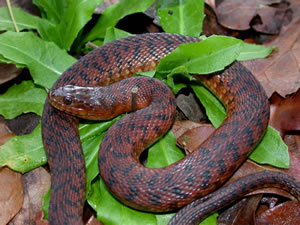
| Description: Nerodia floridana is the largest watersnake in North America, reaching 30-55 in (76-140 cm). Adults are generally solid greenish-brownish with a plain belly that is whitish in color. Juvenile snakes have about 50 dark bars down their dorsum and on their sides, which fade gradually with age. A series of subocular scales separates the eye from the upper lip. A reddish or brown color variant of this species occurs in southern Florida. Females are generally larger than males and have shorter tails. This species was once considered a subspecies of the Western Green Watersnake (Nerodia cyclopion).
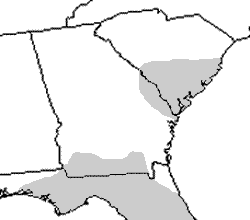
Range and Habitat: Florida Green Watersnakes are endemic to the Southeast. They are found throughout Florida and in parts of southern Georgia. There are two isolated populations, in western and southern South Carolina. They prefer to live in vegetation choked, still waters such as swamps and marshes. They can also be found in lakes, ponds, ditches, and slow rivers and occasionally in brackish water. Habits: Florida Green Watersnakes mate in the spring and bear 10-100 live young from late June to early August. They are primarily diurnal, but they do move across roads at night, and have been known to feed on minnows and other small fishes during twilight. Little is known about their diet, but they presumably feed primarily on larval and adult amphibians and fish. When captured, Green Watersnakes do not hesitate to bite, but they are not venomous. Little is known about the population biology of this species, but research at SREL has shown that populations inhabiting isolated wetlands are more severely impacted by drought than are other watersnakes (Nerodia fasciata, Seminatrix pygaea), and mud snakes (Farancia abacura). Conservation Status: Although the species is doing well in Florida their ranking in Georgia and South Carolina is an S2 (state imperiled), due to their restricted range. Former DDT use by farmers may have reduced population sizes, and many are killed on roads yearly. This species is protected throughout the state of Georgia. Pertinent References: Willson, J. D., C. T. Winne, M. E. Dorcas, and J. W. Gibbons. 2006. Post-drought responses of semi-aquatic snakes inhabiting an isolated wetland: Insights on different strategies for persistence in a dynamic habitat. Wetlands 26:1071-1078. Seigel, R.A., J.W. Gibbons,and T.K. Lynch. 1995. Temporal changes in reptile populations: Effects of a severe drought on aquatic snakes . Herpetologica 51:424-434. Account Author: Brittany Bloom, University of Georgia – edited by J.D. Willson |