

Eastern Diamondback Rattlesnake (Crotalus adamanteus)
VENOMOUS
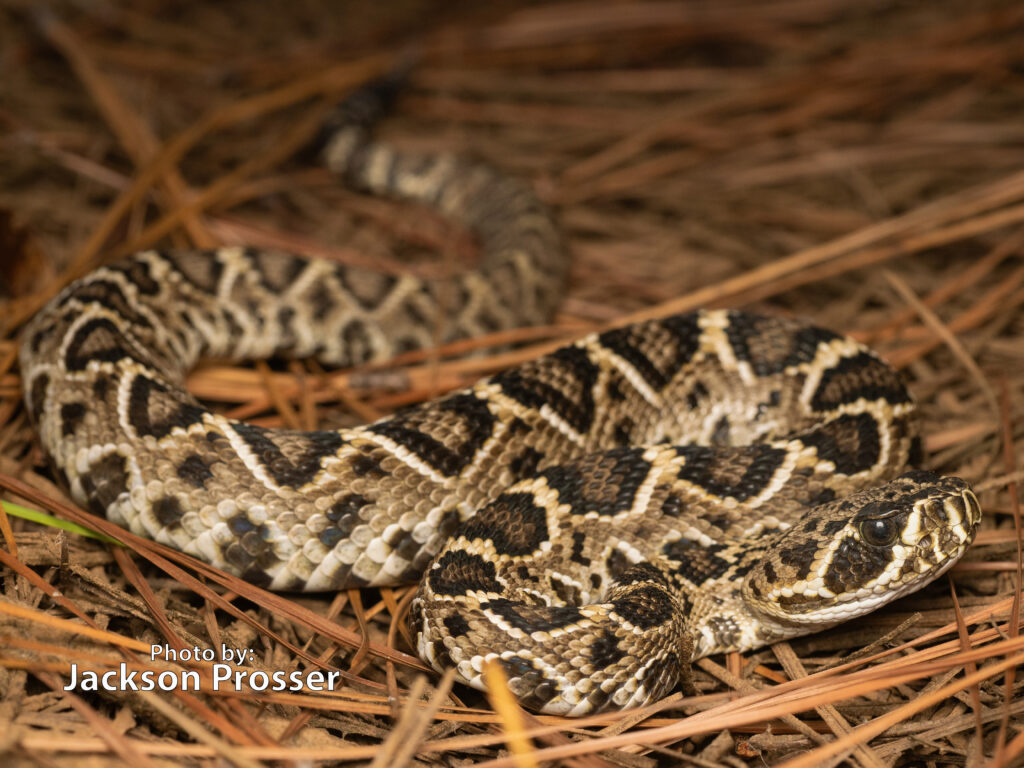


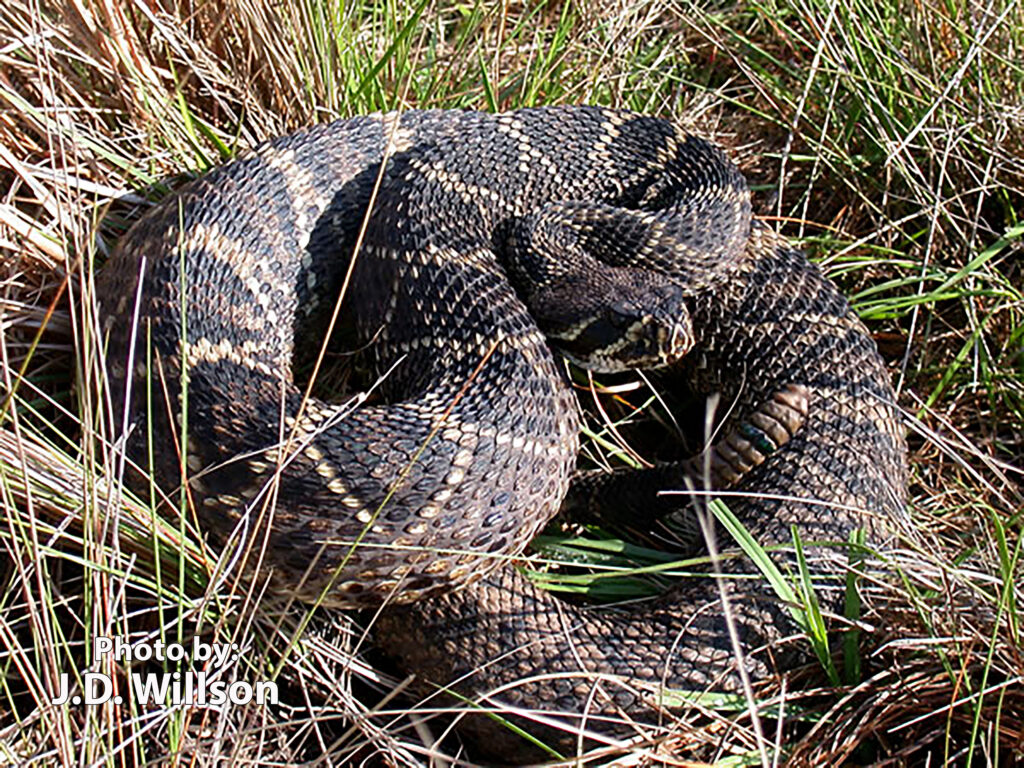
Description: The Eastern Diamondback Rattlesnake is the largest rattlesnake species in the world and the heaviest venomous snake in North America. Adults typically measure 3 -6 ft (0.9 – 1.8 m) in length, with exceptional individuals exceeding 7 ft (2.1 m). It has a massive, thick body, a broad, triangular head, and a large, well-developed rattle at the tail tip composed of keratin (the same durable material found in human hair and nails). The dorsal scales are strongly keeled, contributing to a rough texture, and it has a single anal plate. There are infrared-sensitive pits on each side of the head, located between the eye and the nostril. They are sexually dimorphic in size, with males being longer and having longer tails than females.
Coloration is striking and distinct. The background color ranges from tan to brown or gray, overlaid with a series of dark brown or black diamond-shaped blotches edged in lighter scales along the back. A dark stripe extends from the eye toward the corner of the jaw, bordered by light scales. The tail is often darker near the rattle, contrasting with the body pattern. Juveniles resemble adults but are more boldly patterned and lack a fully developed rattle.
Range and Habitat: The Eastern Diamondback Rattlesnake is native to the southeastern United States but has experienced significant declines throughout much of its historical range. The species is now functionally extirpated in Louisiana, extremely rare in North Carolina, where it is confined to the Lower Coastal Plain south of the Neuse River, and uncommon in South Carolina, only occurring in scattered populations in the lower and middle Coastal Plain and on select barrier islands. Remaining strongholds are found in southern Georgia and Florida, with Florida encompassing approximately half of the species’ current range.
This species is closely associated with longleaf pine ecosystems, including pine flatwoods, sandhills, scrub, coastal dunes, and palmetto-wiregrass communities. It relies heavily on intact, fire-maintained habitats with open understories and abundant cover such as gopher tortoise burrows, which provide refuge from extreme temperatures, predators, and fire. Population declines are largely driven by habitat loss and fragmentation from agriculture, urbanization, and road construction, as well as long-term fire suppression and intentional killing.
Habits: Eastern Diamondbacks are primarily ambush predators, often coiled beside logs, palmetto clumps, or animal burrow entrances while waiting for prey. Activity patterns vary seasonally but tend to be more diurnal in cooler months and become crepuscular or nocturnal during the heat of summer.
Individuals typically maintain large home ranges and show seasonal movement between foraging areas and refugia. Unlike timber rattlesnakes, Eastern Diamondbacks do not use communal overwintering dens but instead rely on a network of burrows and shelters throughout their range.
Their diet consists mainly of small to medium-sized mammals, including rabbits, cotton rats, mice, squirrels, and occasionally birds. Prey is subdued using a strike-and-release strategy, in which venom is injected, the prey is released, and it is then tracked using chemosensory cues until it succumbs. As apex or near-apex predators in pine savanna systems, Eastern Diamondbacks play a critical ecological role by regulating rodent populations. They are preyed upon by raptors, bobcats, coyotes, wild hogs, and kingsnakes, with juveniles particularly vulnerable.
Eastern Diamondbacks are ovoviviparous, giving birth to live young from late July through early October. Mating typically occurs in late summer or fall, and females give birth the following year. Litters range from 7 to 25 live young. Neonates measure about 12–14 in (30–36 cm) and are born with venom and a single rattle button. Females mature slowly and reproduce infrequently, often only once every 2–4 years. This low reproductive rate, combined with delayed maturity, makes populations especially susceptible to decline.
Venom and Bites: Eastern Diamondback venom yields are among the highest of any rattlesnake species. The venom is complex, powerful, and primarily hemotoxic. However, it does contain dozens of other toxins that can affect the blood, tissues, and circulation. The venom interferes with normal blood clotting by breaking down and damaging blood vessels, leading to internal bleeding and the destruction of red blood cells. Although significant external bleeding is uncommon, the venom has strong hemorrhagic and tissue-damaging effects.
Components of the venom can also disrupt nerve and muscle function, cause severe pain, and lead to a sudden drop in blood pressure. Overall, the venom is highly necrotizing, causing extensive tissue damage around the bite site and often accompanied by intense pain, swelling, bruising, and discoloration of the affected limb.
While bites can be medically serious, fatalities are rare with prompt access to antivenin, and any suspected bite should be treated as a medical emergency.
First Aid Protocol: If bitten, move away from the snake immediately and call emergency services. Remain calm and limit movement to slow the spread of venom. Immobilize the affected limb and keep it at or slightly below heart level. Remove constrictive items such as rings or watches, and do not apply tourniquets, cut the wound, or attempt to extract venom.
Conservation Status: Eastern Diamondback Rattlesnakes have experienced severe population declines throughout much of their range due to habitat loss, road mortality, fire suppression, and intentional killing. The widespread loss of longleaf pine ecosystems has been particularly detrimental, exacerbated by the spread of disease. Shifting public attitudes toward rattlesnakes is essential to the conservation of this species, as fear and misunderstanding often lead to snakes being killed during encounters.
The Eastern Diamondback is currently not listed under the U.S. Endangered Species Act. However, it has been petitioned for listing and is under review by the U.S. Fish and Wildlife Service. At the state level, protections vary across its range. It is listed as endangered in North Carolina and is considered a species of concern in South Carolina. Despite its declining population, it is not a protected species in Georgia.
Pertinent References:
- Bauder, J. M., Stevenson, D. J., Sutherland, C. S., & Jenkins, C. L. (2017). Occupancy of Potential Overwintering Habitat on Protected Lands by Two Imperiled Snake Species in the Coastal Plain of the Southeastern United States. Journal of Herpetology, 51(1), 73–88.
- Gold, B., Dart, R., & Barnish, R. (2002). Bites of Venomous Snakes. The New England Journal of Medicine, 347(5).
- Gray, E. R., Wilkinson, S. L., Miller, M. C., Wilkinson, W., Adams, C., Ebert, S., Hitchens, C., Holloway, J., Welch, S. M., & Waldron, J. L. (2025). An emergent disease reduces survival of mature female eastern diamondback rattlesnakes (Crotalus adamanteus), a key demographic for a slow-lived species. Scientific Reports, 15(1).
- Murphy, C., Smith, L., O’brien, J., & Castleberry, S. (2021). Overwintering Habitat Selection of the Eastern Diamondback Rattlesnake (Crotalus adamanteus) in the Longleaf Pine Ecosystem. 203 Herpetological Conservation and Biology, 16(1), 203–210.
- Rokyta, D. R., Lemmon, A. R., Margres, M. J., & Aronow, K. (2012). The venom-gland transcriptome of the eastern diamondback rattlesnake (Crotalus adamanteus). BMC Genomics, 13(1), 312.
- Stohlgren, K., Spear, S., & Stevenson, D. (2015). A Status Assessment and Distribution Model for the Eastern Diamondback Rattlesnake (Crotalus adamanteus) in Georgia.