
Corn Snake (Elaphe [Pantherophis] guttata)

Corn Snake (Pantherophis guttata)

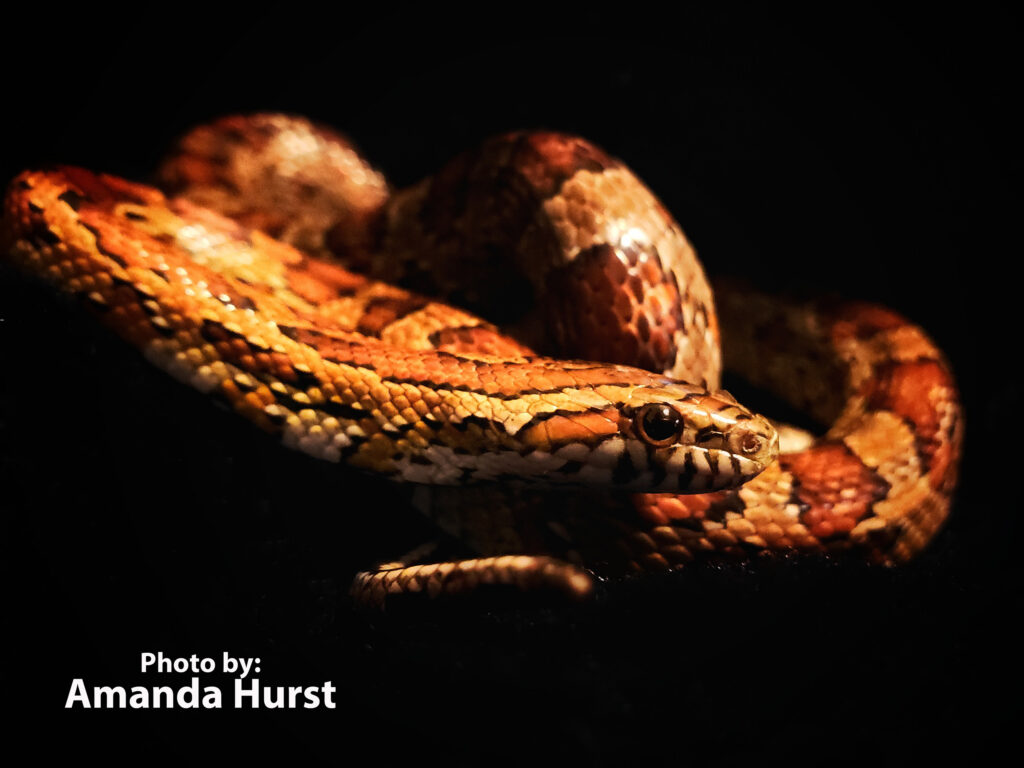


Description: Corn snakes are medium-sized constrictors, with adults typically measuring 3-4 ft (0.91-1.2 m) in total length, though some may exceed 5 ft (1.5 m). The body color ranges from orange to reddish-brown, crossed by 27-40 black-edged blotches, with alternating lateral blotches along the sides. The belly displays a distinctive black-and-white checkerboard pattern, often compared to Indian corn or a piano keyboard. On the head, a spear-shaped marking extends from the neck forward to a point between the eyes, serving as a reliable identification feature. Scales are weakly keeled with a slightly rubbery texture. Geographic variation is evident: snakes from the Coastal Plain are typically bright orange, while those from the Piedmont and uplands tend to appear darker and more subdued. Juveniles resemble adults but are usually drabber, with brown or gray coloration that intensifies in color as the snake matures.
Range/Habitat: Corn snakes range across the southeastern United States, from southern New Jersey, extending south through the Carolinas to the Florida Keys, and westward toward eastern Louisiana. Within this range, they occupy a variety of habitats, including open pine woodlands (e.g., longleaf sandhill habitat), abandoned fields, hardwood hammocks, and agricultural edges. They are often associated with human structures (e.g., barns, sheds), where they exploit rodent populations.
Habits: Corn snakes are primarily crepuscular (active at dawn and dusk), though during the hot season, they become more nocturnal. During the day, they may remain concealed beneath logs, artificial cover, under bark, debris, or in burrows. They exhibit arboreal behavior, meaning they can climb and sometimes use trees or elevated structures. However, they are more terrestrial than other rat snake relatives, such as the closely related Eastern rat snake. Surface activity peaks in warm months, particularly in late spring and early fall, and individuals are often encountered crossing roads on humid nights while foraging or searching for mates.
As corn snakes grow, their diet changes: young snakes mostly eat ectotherms such as frogs and lizards, while adults switch to warm‑blooded prey such as rodents and birds. They also consume bird eggs and have been identified as efficient nest predators of quail and songbirds. Common predators of corn snakes include other snakes (e.g., kingsnakes and racers), birds of prey, and mammals such as opossums, raccoons, and feral cats. Humans are also major sources of mortality through road mortality and direct persecution.
Reproduction occurs in spring, with females laying average clutches of 10-20 eggs in rotting logs, burrows, or other sheltered sites during early summer. After ~60 days of incubation, hatchlings emerge in late summer at lengths of 8-12 in (20-30 cm) and reach maturity in 2-3 years.
Ecologically, corn snakes function as mid-level predators, regulating small mammal and bird populations while serving as prey for raptors, mammals, and larger snakes. In managed pine systems, frequent fire helps maintain the open upland habitats they favor.
Conservation: In some regions, corn snakes are considered common, but habitat loss, fragmentation, road mortality, and collection for the pet trade can have detrimental effects on their populations. Their adaptability allows them to persist in agricultural and suburban environments. However, they are often killed due to confusion with venomous species such as copperheads. Corn snakes are listed as stable and are protected in the states of Georgia and South Carolina.
Pertinent References:
- Astley, H.C., and B.C. Jayne. 2009. Arboreal habitat structure affects the performance and modes of locomotion of corn snakes (Elaphe guttata). Journal of Experimental Zoology Part A: Ecological Genetics and Physiology 311:207-216.
- Sash, K.J. 2007. Snake ecology of the Red Hills region of south Georgia and north Florida. M.S. Thesis, University of Georgia, Athens, Georgia. 122 pp.
- Kravchuk, J.L., and K.B. Watson. 2020. Comparison of growth rate, fertility, and survival of corn snakes (Pantherophis guttatus) under laboratory conditions. Acta Biologica Szegediensis 64:71-79.