
Dwarf Waterdog (Necturus punctatus)

Photos by Amanda Hurst unless otherwise noted
Description: Ranging from 11.5 to 15.9 cm (4.5 – 6.25 in.), the dwarf waterdog is the smallest species in the genus Necturus. It has a brown, gray, or black dorsum with no conspicuous markings, and a whitish throat. The dark dorsum coloration extends to the sides of the belly, and the center of the belly is white. It has four toes on each foot, and reddish external gills.
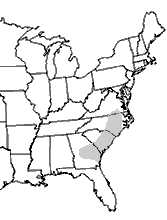
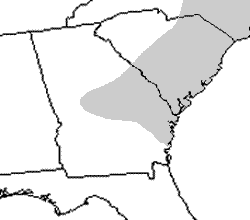
Range and Habitat: Dwarf waterdogs inhabit slow, sluggish streams and swamps in the Southeastern Coastal Plain with abundant leaf litter and debris substrates. They can also be found in flooded fields and irrigation ditches. They are particularly common in “blackwater” cypress streams.
Habits: These salamanders are opportunistic feeders, preying on mostly aquatic insects, crustaceans, and worms. Hatchlings appear in fall, so it is assumed that eggs are laid in spring. They have a life span of over 10 years.
Conservation status: Locally common.
Pertinent Reference:
Meffe, G. K. and A. L. Sheldon. 1987. Habitat use by dwarf waterdogs (Necturus punctatus) in South Carolina streams, with life history notes. Herpetologica 43(4): 490-496.
Account Author: Aaliyah Greene, University of Georgia – revised by J.D. Willson