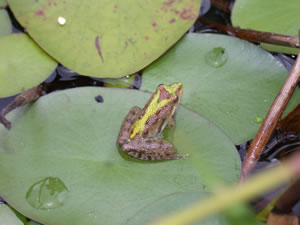
Southern Cricket Frog (Acris gryllus)
Southern Cricket Frog (Acris gryllus)
Southern Cricket Frog Call
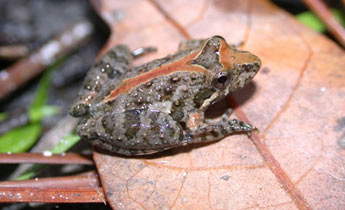
Description: Southern cricket frogs are small, warty frogs (1.6–3.5 cm SVL) with relatively long hind limbs and no toe pads. Dorsal coloration varies (gray, brown, or green), often with a faint mid-dorsal stripe and a triangular interorbital blotch. Similar in appearance to the Northern cricket frog (A. crepitans) and best distinguished by call or range. Both species have a dark stripe on the thighs; in Southern cricket frogs (A. gryllus), the stripe is straight and clean-edged, bordered by a pale line, whereas in the Northern cricket frog (A. crepitans), it is jagged.
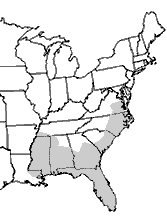
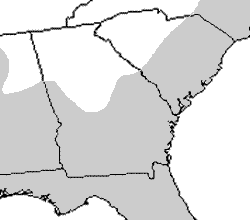
Range and Habitat: Occurs primarily in the Coastal Plain of the southeastern United States, where it generally replaces the Northern cricket frog (A. crepitans). Found in various moist environments, particularly the margins of ponds, lakes, ditches, and slow-moving streams. Prefers shallow, open water with abundant vegetation. Not arboreal; rarely climbs.
Habits: The call is a rapid “clicking” resembling marbles tapped together, but generally slower than the call of the Northern cricket frog (A. crepitans). Breeding takes place in spring and summer. Insectivorous, feeding on small arthropods. Males defend calling sites during the breeding season but are less aggressive than the Northern cricket frog (A. crepitans).
Conservation Status: Widespread and abundant throughout the Southeast with no significant conservation concerns at present.